



Understanding the Inhibitory Effect of Social Security Confidence on Rural Consumption Expenditure in China: An Econometric Case Study
Jiahui Song *
Business School, Huaiyin Institute of Technology, Huaian 223300, China.
Mancheng Liu
Business School, Huaiyin Institute of Technology, Huaian 223300, China.
Yingying Lu
Business School, Huaiyin Institute of Technology, Huaian 223300, China.
*Author to whom correspondence should be addressed.
Abstract
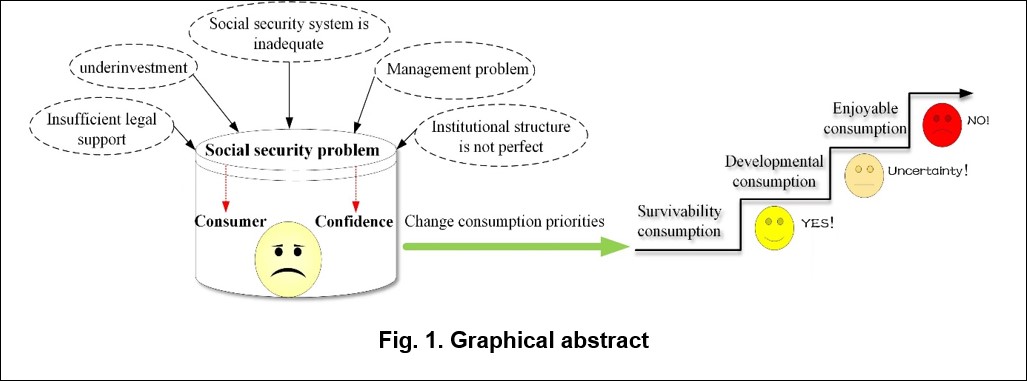
The urban-rural consumption expenditure gap poses a significant obstacle to economic development. From a psychological perspective, this study employs a 4-period panel dataset constructed from the CPFS database to empirically analyze the inhibitory effect of insufficient social security confidence on the consumption expenditure of rural residents. The results demonstrate that a one-point decrease (on a 10-point scale) in rural residents' confidence in social security reduces their consumption expenditure by 0.027 ten thousand yuan. Furthermore, it hinders the optimization and upgrading of their consumption structure: notably, a one-point decline in social security confidence reduces developmental and recreational consumption by 0.052 and 0.037 ten thousand yuan, respectively, significantly exceeding the reduction in survival consumption. Additionally, the study finds that rural residents characterized by non-agricultural employment, male gender, higher education levels, or urban residence exhibit stronger tendencies to curtail consumption and accumulate savings when experiencing low social security confidence.
Keywords: Social security confidence, rural consumption market, consumer confidence, consumption willingness, urban-rural disparities in social security